
Introduction
Anyone who’s tried renting commercial space in Bangalore has run into the same wall. A landlord quotes a reasonable monthly rent, and then mentions the security deposit, often six to ten months’ worth, paid entirely upfront, before a single day of work has happened in the space. For a small business or an early-stage startup, that single number can swallow months of runway before the office even has furniture in it.

This is exactly why office space in Bangalore without security deposit has become such a common search, and such a genuine relief once people realize it actually exists as an option. Coworking and flexible workspace providers have built their entire pricing model around avoiding this exact problem, and understanding how that works, and why traditional deposits got so high in the first place, makes the decision between a lease and a flexible workspace much clearer.
Table of Contents
- Why Security Deposits in Bangalore Are So High
- Is There a Legal Cap on Commercial Security Deposits
- What Counts as a Normal Deposit in Bangalore
- How Office Space in Bangalore Without Security Deposit Actually Works
- What You Give Up, and What You Don’t
- Will You Get Your Deposit Back If You Do Pay One
- Coworking vs Traditional Lease on Upfront Cost
- What to Check Before Choosing a No-Deposit Option
- Who Benefits Most From Skipping the Deposit
- FAQ
- Final Thoughts
Why Security Deposits in Bangalore Are So High
Commercial security deposits in Bangalore have historically run far higher than in most other Indian cities, often stretching to ten months’ rent in commercial hotspots like Koramangala, HSR Layout, and Whitefield. Part of this comes down to landlords treating the deposit as a low-cost source of capital, since the money sits with them, earns nothing for the tenant, and effectively functions as an interest-free loan for the duration of the lease. Part of it also comes from landlords protecting against non-payment or property damage, though the scale of deposits demanded in Bangalore has long outpaced what similar cities consider standard.
This has been a genuine, widely discussed frustration among renters and businesses for years, with entire online communities dedicated to comparing notes on just how aggressive these demands can get, and how little negotiating power an incoming tenant typically has.
Is There a Legal Cap on Commercial Security Deposits
This is genuinely changing, and it’s worth knowing about. New rental rules introduced in 2025 have capped security deposits at two months’ rent for residential properties, and six months’ rent for commercial properties, meaning any amount charged beyond that cap is technically excess under the new framework. This is a meaningful shift from the informal norm of six to ten months that had become standard practice in much of the city, particularly in high-demand commercial corridors.
That said, enforcement and awareness of this cap are still catching up to the rule itself, and many landlords continue operating on old norms simply because tenants haven’t pushed back. Knowing the legal cap exists is useful leverage in any negotiation, even before considering a fully deposit-free coworking option instead.
What Counts as a Normal Deposit in Bangalore
Even with the new cap in place, what tenants report actually being asked for varies widely. A ten-month deposit has been described as the going norm in Koramangala, HSR, and Whitefield specifically, largely because landlords in these high-demand pockets know there’s no shortage of businesses willing to pay it to secure a good location. In other parts of the city, three to six months has traditionally been treated as more reasonable, and is now the legal ceiling for commercial space regardless of neighborhood.
The practical reality is that even a six-month deposit on a mid-range commercial space, at say sixty thousand rupees a month, works out to three hundred and sixty thousand rupees paid upfront, before rent itself even starts counting. For a business at an early stage, that’s not a small number to have locked away and inaccessible.
How Office Space in Bangalore Without Security Deposit Actually Works
Coworking and flexible workspace providers structure their pricing entirely differently from a traditional lease, and this is exactly where office space in Bangalore without security deposit becomes a realistic option rather than a workaround. Instead of a large upfront deposit tied to a multi-year lease, most coworking memberships run on a monthly, rolling basis, with no deposit requirement at all, or in some cases a small, refundable amount equivalent to a single month’s fee rather than six or ten months’ worth.
This works because the provider is renting a desk, a cabin, or a floor within a much larger space they already manage, rather than handing over an entire independent unit the way a traditional landlord does. The risk profile for the provider is fundamentally different, and that difference in risk is exactly what removes the need for a large deposit.
What You Give Up, and What You Don’t
It’s worth being honest about the tradeoff here rather than presenting it as a pure upgrade. A traditional leased office, once the deposit is paid, generally offers full control over the space, the ability to build it out exactly to a company’s specifications, and no shared amenities or shared foot traffic. A coworking or flexible plan without a deposit generally comes as a fully furnished, ready-to-use space, with shared amenities like meeting rooms, Wi-Fi, and common areas, but less room for permanent customization of the physical space itself.
For most early-stage businesses and growing teams, this tradeoff favors the flexible option heavily, since the ability to redirect several months’ worth of rent-equivalent cash into the actual business, rather than a landlord’s deposit account, tends to matter more than full customization of a space in the first year or two.
Will You Get Your Deposit Back If You Do Pay One
This is a real concern, and not an unfounded one. There are widely shared, well-documented stories of tenants paying deposits in the range of seventy thousand rupees and receiving back a fraction of that amount, sometimes as little as a quarter, after deductions the landlord claims were necessary but rarely itemizes clearly. This uncertainty around deposit recovery is a significant part of why office space in Bangalore without security deposit has become such an attractive alternative, it removes not just the upfront cost, but the entire dispute-prone process of trying to recover that money later.
Coworking vs Traditional Lease on Upfront Cost
The gap in upfront cost between these two options is stark enough to be worth stating plainly. A traditional commercial lease, even under the new six-month legal cap, still requires a substantial lump sum before move-in, plus typically a security check, background verification, and a formal multi-year lease commitment. A coworking membership without a deposit requirement typically asks only for the first month’s fee, sometimes with a short notice period for cancellation rather than a fixed lease term at all.
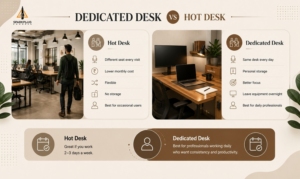
For a business trying to preserve cash in its early stages, or simply avoid tying up capital in a deposit that may or may not be fully returned years later, this difference is often the deciding factor over any other consideration, including the office’s finishes or exact square footage.
What to Check Before Choosing a No-Deposit Option
Before signing up for any coworking or flexible workspace plan marketed as deposit-free, it’s worth confirming the actual terms rather than assuming “no deposit” means no cost at all upfront. Ask whether the first month’s fee is due in advance, and whether there’s any refundable holding amount, even if it’s much smaller than a traditional deposit. Confirm the notice period required to end the membership, since this replaces the lease term as the main commitment involved. And check what happens to any unused portion of a prepaid month if the membership ends early, since policies vary meaningfully between providers on this point.
Who Benefits Most From Skipping the Deposit
Early-stage startups and founders operating on tight runway are the clearest beneficiaries, since redirecting several months’ worth of deposit money into hiring, product, or marketing usually matters more at that stage than having a fully customized office. Freelancers and small consultancies benefit similarly, particularly those who aren’t certain yet how much space they’ll need in a year and don’t want capital locked into a long-term commitment that assumes growth that hasn’t happened yet. Businesses expanding into Bangalore from another city also benefit, since a large upfront deposit on an unfamiliar market carries more risk than the same commitment somewhere they already have established relationships.
FAQ
- Why do office spaces in Bangalore charge such high security deposits?
Deposits function partly as a low-cost source of capital for landlords, and demand in commercial hotspots has historically let landlords ask for six to ten months’ rent upfront. - Is there a legal limit on commercial security deposits in Bangalore?
Yes, new rules introduced in 2025 cap commercial security deposits at six months’ rent, though enforcement of this cap is still catching up to widespread landlord practice. - What’s a normal security deposit for office space in Koramangala?
Historically around ten months’ rent in high-demand pockets like Koramangala, HSR, and Whitefield, though this now exceeds the legal cap for commercial properties. - Can I rent office space in Bangalore without paying a security deposit?
Yes, most coworking and flexible workspace providers operate on a monthly, rolling basis with no large deposit requirement, unlike traditional commercial leases. - Will I get my full security deposit back when I move out?
Not always, tenants have reported receiving back only a fraction of large deposits after unclear deductions, which is a major reason deposit-free coworking has become a preferred alternative.
Final Thoughts
Office space in Bangalore without security deposit isn’t a workaround or a lesser option, it’s simply a fundamentally different pricing model built around monthly flexibility instead of a large upfront lock-in. For a business trying to preserve cash, avoid a drawn-out deposit dispute down the line, or simply move quickly without a multi-year commitment, it’s usually the smarter starting point.
SparkPlug’s plans are structured around exactly this kind of flexibility, no large upfront deposit, and no long-term lease required. Come see the space, and talk through what fits your business right now.